

I Sing of Artemis
I. The Hymn We Didn't Know We Were Singing
There is a kind of utterance that doesn't describe a thing — it summons it. When a priest says the words of consecration over bread and wine, he is not reporting on a transformation. He is performing one. When a shaman calls the directions, she is not acknowledging the four winds as a pleasantry. She is opening the door. Language, in its oldest and most honest form, was never primarily for communication. It was for invocation.
Neil Gaiman understood this. In American Gods, the old deities — Anansi, Czernobog, Bilquis, the Allfather himself — survive in America not through temples or tithes but through the quality of human attention directed toward them. Belief is a substance in Gaiman's cosmology; it can be hoarded, spent, weaponized, or withheld. And the gods who are forgotten do not retire peacefully. They diminish. They haunt gas stations and funeral parlors. They wear the faces of the forgotten and drive through a country that no longer knows their names.
But what happens when a name returns?
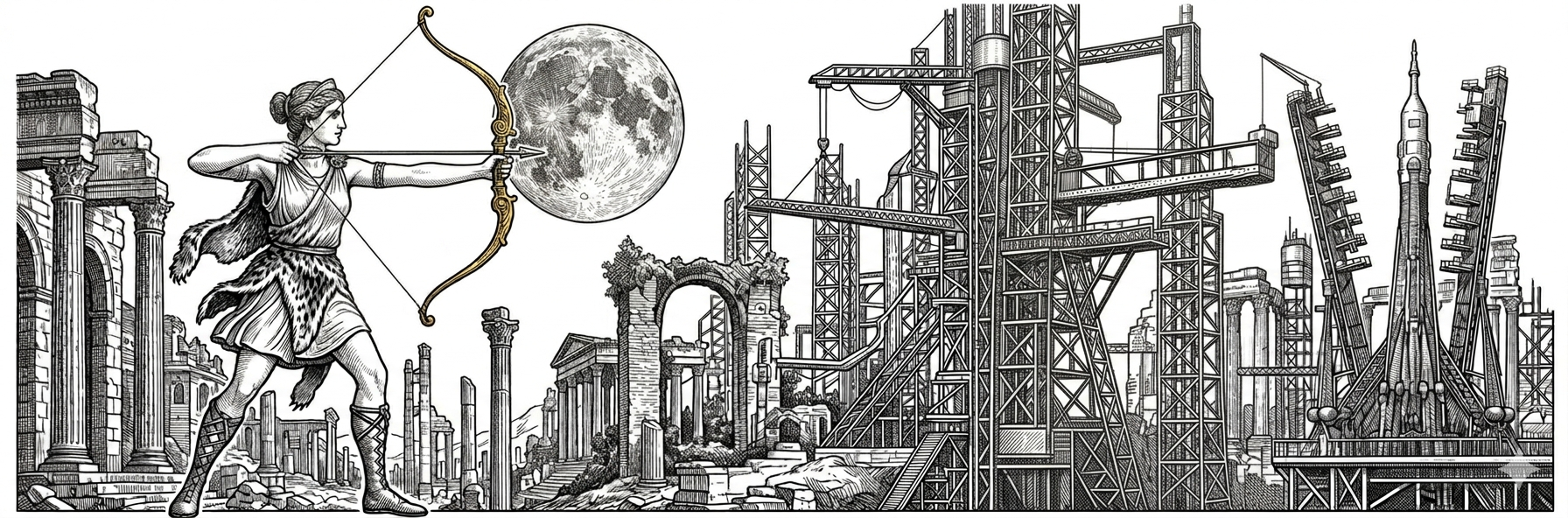
In 2017, NASA announced it: the program to return humanity to the moon would be called Artemis. Her brother's name — Apollo — had already been written into the architecture of the first moon missions fifty years prior. Now the Orion crew vehicle carries the name of the hunter whose belt still burns across the winter sky; the rocket itself bears the name of the goddess who governs the moon she was born under, the twin who ran beside her brother through every myth the ancient world ever told about them both.
The engineers who named these missions were not, presumably, theologians. They were reaching for poetry in the naming the way engineers sometimes do — searching for something larger than a serial number to hold the weight of what they were attempting. They found her. Or — and this is the question your practice asks you to sit with — she found them.
Because here is what happens when you name Artemis in front of millions of people who are already looking upward with awe: you feed her. Every livestreamed launch. Every child who learns to say her name and lifts her eyes toward the moon. Every news anchor who speaks of the Artemis program with that particular species of secular reverence that is functionally indistinguishable from worship — all of it is nourishment. All of it lands somewhere in the field.
The tops of the high mountains tremble. The tangled wood echoes. The sea responds where fishes shoal.
She is being fed. She is rising.

II. Who She Actually Is
Before we go any further — let me tell you who she actually is…the true Archetype of Artemis. Not the greeting card version.
She is the goddess of every threshold where life gets dangerous. Of birth and wilderness and the liminal space between worlds. Her name in Greek means unmoved — not cold and distant, but stable in the way that ancient things are stable; the kind of firm that holds its shape under pressure that would flatten everything smaller. She is the huntress and the nurturer, the one who saved the abandoned infant Atalanta and the one who demanded a king's daughter on the altar. She carries a torch as often as a bow — and in the dark, she was identified with Hecate, queen of crossroads, companion of the threshold-walkers. She is not a safe goddess. She is a true one.
Yet of all her aspects, perhaps none is less spoken of and none more necessary in this particular moment than this: she is also Kourotrophos. Child-nurturer. Keeper of the young at the threshold of becoming. And I believe that it is this blessing of Artemis that the Collective is calling in at this time.
III. Kourotrophos — The One Who Nurtures the Young
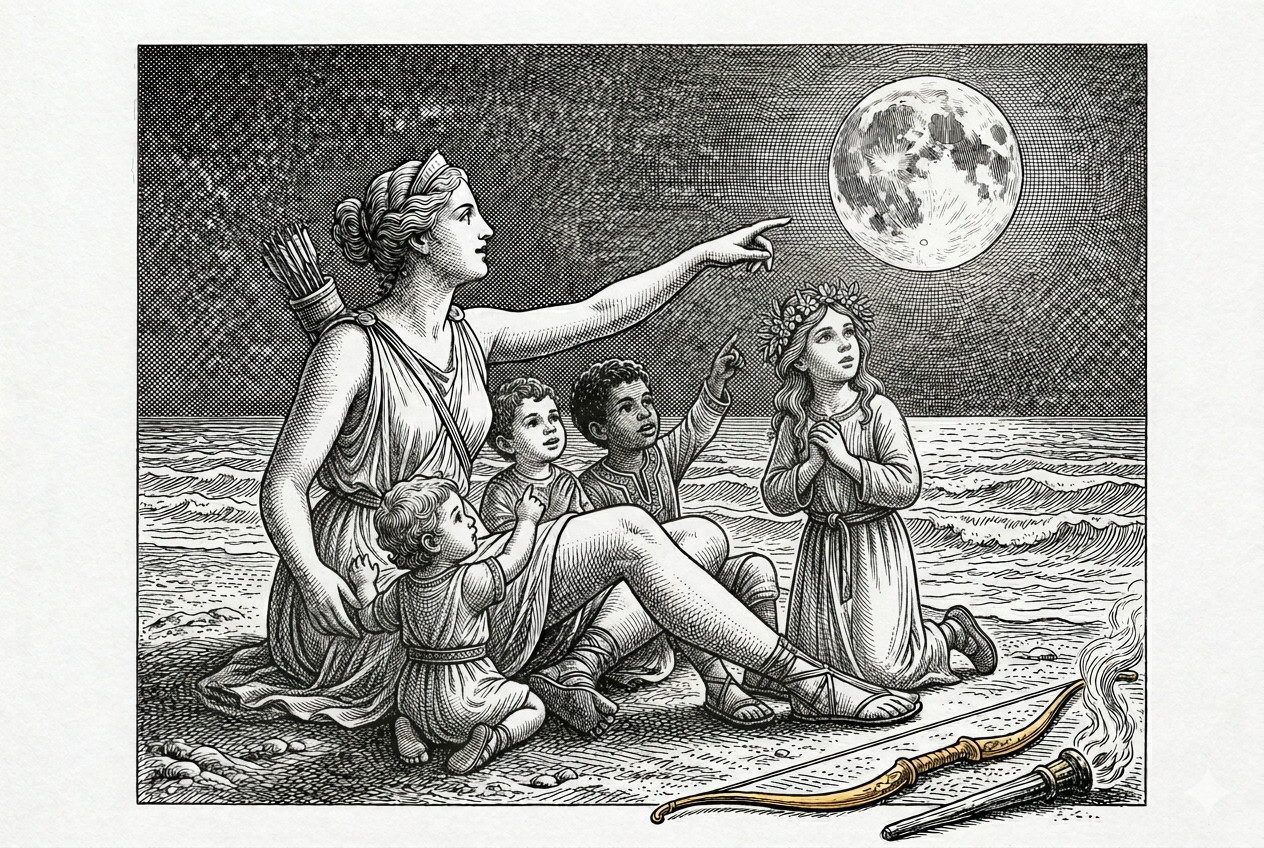
This epithet belonged to a cluster of deities in ancient Greece — gods and goddesses whose sacred office included guarding children through the dangerous passage of becoming. Artemis held it alongside her silver bow and her vow of perpetual sovereignty. She was present at the threshold of birth. She accompanied the young into the wilderness of adolescence. She stood between the vulnerable and the world that would consume them. The Kourotropheion — her sanctuary in Athens under this name — was a place of sacrifice and supplication on behalf of children, on behalf of the future.
She was, in her fullness, both the arrow and the shelter. Both the fierce maiden who runs alone through the peaks and the one who turns to stand between the children and whatever is hunting them.
I need you to hold that image now, because I need to say what I cannot stop seeing.
Children. Every day. Everywhere I turn. Under rubble and in refugee camps and in the villages that don't make the news cycle. Hundreds of them. Not as collateral. As targets. As acceptable loss. As the cost of something the adults around them decided mattered more.
The Kourotrophos is being fed on one side of the sky — her name spoken upward with wonder, carried on rockets toward the stars. And on the other side of the same sky, the ones she is sworn to protect are dying in numbers that should stop the world from turning.
This is the oldest theological wound there is. It does not have a clean answer. It has never had a clean answer. And anyone who offers you one — any tradition, any cosmology, any spiritual framework that resolves this into meaning without first sitting in the full weight of its horror — is practicing a kind of bypass so sophisticated it wears the face of wisdom.
Where are you? Where is the Kourotrophos? Where is the one who was sworn to guard the threshold?
I have asked this question. I have screamed it, in the dark, into the nothing. I have written it in the margins of the books that were supposed to explain it to me. I have carried it into ceremony and set it on the altar and waited.
The answer that came was not comfort. It was not explanation. It was something harder and truer than either.

IV. The Sovereign Arrow
I came to Artemis the way most women come to her — sideways, through a wound.
There was a time in my life when I was in a particular kind of pain that doesn't have a dignified name; the pain of being, as I experienced it, actively unwanted. A partner's withdrawal. The particular shame that attaches itself to rejection — the narrative the wound tells about what it means, about what you are, about why you were found insufficient. That story is a cage. It has the texture of truth and the architecture of a trap, and I lived inside it longer than I want to admit.
What shifted was not a healing, exactly. It was a reframe that arrived with the force of revelation: what if this is not rejection? What if this is the arrow turning inward? What if what looks like lack is actually the beginning of sovereignty?
Because I had just spent time sitting with who Artemis actually is. Not the sanitized version — the real one. The one who covered her face with mud so the river god couldn't recognize her. The one who was unmoved — not because she felt nothing, but because nothing could capsize the fundamental fact of her self-possession. The one who transformed every man who tried to make her into an object of his wanting.
I understood, in that moment, that what I had been calling rejection was actually an invitation. Not into isolation — into the kind of aloneness that has agency in it. Sacred celibacy not as punishment or as waiting, but as the reclamation of energy that had been flowing outward in supplication — please want me, please choose me, please confirm that I am enough — and redirecting it toward something else entirely. Toward the work. Toward the altar. Toward the essay that needed writing and the client who needed holding and the ceremony that needed someone willing to stand at the threshold and not flinch.
She taught me that sovereignty is not the absence of longing. It is the refusal to let longing run you.
And here is where the answer to the theological wound lives — not in comfort, but in archetype:
The Kourotrophos is not absent from those children. She is present in every person who refuses to look away. She is present in the doctor who performs surgery by flashlight in a basement. She is present in the journalist who keeps filing dispatches from the place the world has decided to forget. She is present in every mother who covers her child's body with her own. She is present in every voice that speaks the names of the dead when the powerful have decided the dead don't have names worth speaking.
She does not prevent. She accompanies. She stands at the threshold between this world and the next — torchbearer in the dark, Mistress of the In-Between — which is exactly what a psychopomp does, what a Kourotrophos does, what a shaman does, what anyone does who has decided that witness is a form of love and presence is a form of protection even when it cannot be a form of rescue.
She is fed by wonder and by rage in equal measure. The millions who look upward at her rocket and feel that secular awe — that feeds her. And the grief and fury of everyone who says the names of the children and refuses to be consoled by explanation — that feeds her too. Both are devotion. Both are prayer. Both are the hymn.
She is unmoved — not because she doesn't feel it. Because feeling it fully is precisely what she was built to do without breaking.
And the invitation — the one she extends from the peaks, from the moon, from the launchpad, from the rubble — is not to resolve the tension. It is to stand inside it with your full weight. To become, in your own body and your own practice and your own particular life, a vessel stable enough to hold what the world is asking you to hold. To take the arrow of your grief and your rage and your awe and your longing and aim it — deliberately, sovereignly — at something that matters.
The engineers spoke her name and pointed it at the stars. A generation of children looked up and felt something ancient stir in their chests without knowing why. I took her name into my body and let it reorganize something that had been living in me as shame.
These are not separate events. They are the same event, at different scales. Belief is a substance. Attention is nourishment. And a goddess fed on enough human awe and enough human fury becomes something that can hold the unbearable weight of the world's grief — not by removing it, but by being large enough, firm enough, unmoved enough to contain it.
I sing of Artemis.
I sing of her over the shadowy hills and the bombed-out cities.
I sing of her into the dark where the children have gone.
I sing of her from a body I have reclaimed as my own.
The mountains tremble. The sea responds.
She is here. She is listening. She is being fed.
And so are we.

Tendrils — For Your Own Reflection
1. What name have you been speaking into the world that you didn't know was an invocation? What have you been feeding, consciously or not, with the quality of your attention?
2. Artemis means unmoved — stable enough to hold what would break anything smaller. Where in your life are you being asked to be that vessel? What would it mean to be that size?
3. Where does lack feel like deprivation — and what would it mean to reframe it as the beginning of sovereignty? What becomes available when you stop waiting to be chosen?
4. Who are you willing to witness? Whose name are you willing to speak when the world has decided to forget them? That willingness is not separate from your spiritual practice. It is the center of it.
5. The Kourotrophos stands at the threshold between this world and the next. Where are you being called to stand — not to rescue, but to accompany? Not to explain, but to hold?
